|
Artima Zines
RSS Feeds
To subscribe to the Artima Newsletter, please create an Artima Account and select the Artima Newsletter checkbox.
Advertisement
|
by Sean Landis, from No Pidgeon Holes, Please, January 5, 2009,
Contrarians reject the majority opinion and often have personal reasons to degrade Agile. These writings often disqualify themselves through bias, thus failing to benefit the community. But non-contrarians - practitioners who tend to support the majority view - may be in the best position to drag the skeletons out of the closet.
Sponsored Links
by Michele Simionato, from The Explorer, January 2, 2009,
A mixin is a collection of methods that can be injected into a class.
The mixin technique consists in building classes by composing reusable mixins. The advantages and disadvantages of the technique are very much debated. I will focus on the negative aspects.
by Bill Venners, from Angle Brackets and Curly Braces, December 30, 2008,
The next version of ScalaTest will include a set of matchers. These matchers demonstrate the kind of DSL notation you can create in Scala. In this post, I give a sneak preview of ScalaTest matchers, and ask for feedback.
by Bill Venners, from Angle Brackets and Curly Braces, December 25, 2008,
The latest version of ScalaTest includes a trait named SpecDasher, which when mixed into a Spec facilitates a more concise expression of specification-style tests. It is deprecated, however, and may be removed in a future release depending on user feedback. What's your opinion?
by Bill Venners, from Angle Brackets and Curly Braces, December 25, 2008,
The latest version of ScalaTest, a testing tool for Scala and Java developers, includes a concise way to test private methods and support for behavior-driven development.
by Josh Long, from Full contact Java Programming, December 22, 2008,
Old 2.0 (I've got more; stop me if you've heard them before.)
by Martin Odersky, from Ideas, Languages, and Programs, December 18, 2008,
Busting some myths that have sprung up around Scala.
by Bill Venners, from Angle Brackets and Curly Braces, December 18, 2008,
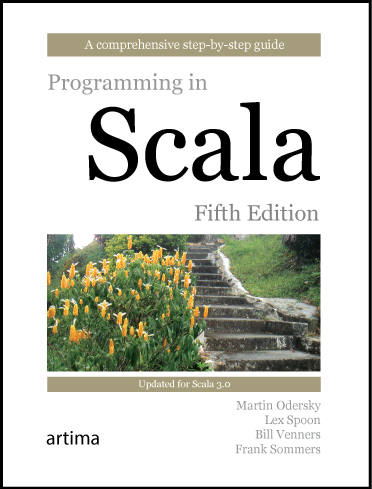
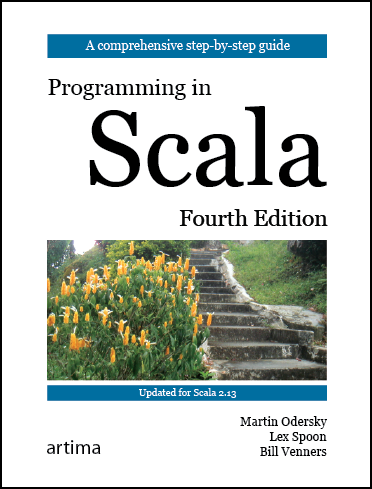
Artima's first published book, Programming in Scala, made its bookstore debut last week at the Devoxx conference in Antwerp, Belgium, where it sold out. Twice.
Posted by Frank Sommers, December 17, 2008,
One of the most significant new features in the upcoming Java Persistence API 2.0 specification is a type-safe criteria-based query API. In a recent blog post, JSR 317 spec lead Linda DeMichiel provides a tutorial introduction to this new feature.
Posted by Frank Sommers, December 16, 2008,
In a recent essay, Martin Fowler wonders whether the advent of domain-specific languages will fulfill the long sought-after era of business users being able to craft their own software.
by Bruce Eckel, from Computing Thoughts, December 12, 2008,
Publicly-held corporations ostensibly serve the people they sell products to, but are required by law to actually serve their shareholders. Privately-held companies only serve the customer.
Posted by Frank Sommers, December 11, 2008,
In the latest installment in his series on real-world Scala, Jonas Bonér describes how Scala's mixin composition assists in creating type-safe solutions to cross-cutting application concerns.
Posted by Frank Sommers, December 9, 2008,
Google recently released a prototype environment, Native Client, that allows native applications to run safely inside a browser. The effort joins similar tools, such as Adobe's Alchemy, that aim to merge existing native applications and libraries into Web applications.
Posted by Frank Sommers, December 5, 2008,
In this interview with Artima, Octavian Tanase, Sun's senior director for the Java platform group, explains why JavaFX is relevant for today's Web-based applications, how developers and designers can work together with JavaFX, and the sorts of applications JavaFX is especially suited for.
Posted by Frank Sommers, December 3, 2008,
In a recent essay, CIO Magazine's Esther Schindler flips the usual question about programmer excellence, and tries to find if traditional software metrics have anything to do with identifying the least desirable member of a development team.
Posted by Frank Sommers, December 3, 2008,
The advent of the Java Kernel in Sun's latest JDK update was but the first step toward modularizing the entire Java SE platform, writes Mark Reinhold in a series of blog posts. Reinhold introduces the problems of a modular Java SE, reviews existing module systems, and outlines the proposed direction for Java modularization.
by Michele Simionato, from The Explorer, December 2, 2008,
I am asking the users of my decorator module if they would accept a new version breaking backward compatibility in a minor way.
View archived Artima Developer Spotlight posts.
|
New in Weblogs
• Ubuntu on the EeePC by Michele Simionato
• ScalaTest Matchers Preview by Bill Venners
• Flex/AIR Jam Right Before the Roundup by Bruce Eckel
• The New Old by Josh Long
Advertisement
Hottest Discussions
• Version Control is Undo
81 replies (Weblogs Forum)
• Martin Fowler on Business-Readable DSLs
26 replies (Artima Developer Spotlight Forum)
• Will Open-Sourcing Java Remove Competetive...
19 replies (Weblogs Forum)
• Who's the Worst Programmer on Your Team, and How...
47 replies (Artima Developer Spotlight Forum)
• Programming in Scala Leaps onto the World Stage!
13 replies (Weblogs Forum)
• The Myth Makers 1: Scala's "Type Types"
13 replies (Weblogs Forum)
• Paper book order status
11 replies (Programming in Scala Forum)
• Mixins considered harmful/1
8 replies (Weblogs Forum)
• Native Apps in the Browser
5 replies (Artima Developer Spotlight Forum)
• Traps & Pitfalls of Agile Software...
5 replies (Weblogs Forum) New in Buzz
• Backups: a cautionary tale
by Charles Miller
• Continuous Integration Myth: Large Teams Only
by Jason Sankey
• Twitter
by Jonathan Crossland
• Smalltalk in Dallas
by James Robertson
• TwitterFX 0.15 Release notes
by Steven Herod
|